Best pokies in Brisbane: claims and venue facts
 Available in AU
A practical guide to assessing game claims, checking Brisbane venue details and understanding why past results cannot forecast a spin.
- Pokies in Brisbane: What “Best” Can—and Cannot—Mean
- Finding a Venue That Is Open: Check the Venue, Not the Search Snippet
- Brisbane Pokies Venues and the Limits of Venue-Level Comparisons
- Online Pokies Searches from Brisbane: The Legal Boundary
- Deposits, Bonuses and the Cost Behind the Headline
- Searching Near the Airport: What Location Results Cannot Confirm
- “24-Hour Pokies” and the Difference Between Search Terms and Venue Hours
- South Brisbane and South Bank: No Verified Local Venue Guide
- Brisbane CBD Clubs and Pokies: What the Available Facts Leave Out
- Crown Brisbane Pokies: A Search Query Is Not Verification
Pokies in Brisbane: What “Best” Can—and Cannot—Mean
“Best” sounds like a settled verdict. In practice, it depends on what is being compared: a game’s features, its published return setting, or the experience of a particular venue. Those are different questions, and one answer cannot stand in for all of them. A familiar title is not automatically a better choice, and a busy room is not evidence that its machines pay more.
I have seen promotional language make these distinctions disappear. “Best paying” can sound like a promise about what happens next, when a return percentage describes a theoretical rate across play over time. It does not predict the result of an individual session, or identify where a particular player will win. That gap matters. A figure can look precise and still say little about the next spin.
Each pokie spin is an independent random event determined by a Random Number Generator. Previous results do not make a machine “due”, and a run of wins does not establish that another win is more likely. The same applies in reverse: a run of losses does not create a guarantee of recovery. In operational terms, a machine does not remember that it has been quiet. The next result is separate.
Choosing pokies in Brisbane is easier when you can check the available details behind each option. Use these verdicts as a quick reference when deciding which operators to explore.
Payout speed: crypto 30-120 minutes, fiat 24-72 hours · Min. deposit: A$30 MrPacho lists a minimum deposit of A$30. Withdrawals are stated as taking 30–120 minutes for crypto and 24–72 hours for fiat.
License: Curacao eGaming (Hollycorn N.V., since 2017) · Min. deposit: A$20-30 (depends on the offer) Playfina Casino is licensed by Curacao eGaming under Hollycorn N.V., with the licence in place since 2017. Its minimum deposit is A$20–30, depending on the offer.
License: Curacao Gaming Control Board OGL/2023/174/0082 (Dama N.V.) SpinsUp holds a Curacao Gaming Control Board licence, OGL/2023/174/0082, under Dama N.V.
License: Curacao Gaming Control Board JustCasino is licensed by the Curacao Gaming Control Board.
License: Curacao eGaming OGL/2024/923/0383 (Antillephone N.V.) · Min. deposit: A$30 WinSpirit Casino holds a Curacao eGaming licence, OGL/2024/923/0383, under Antillephone N.V. Its minimum deposit is A$30.
License: Curacao eGaming (Roby Games Ltd) Roby Casino is licensed by Curacao eGaming under Roby Games Ltd.
License: Curacao Gaming Control Board (TechSolutions Group N.V.) Bizzo Casino holds a Curacao Gaming Control Board licence under TechSolutions Group N.V.
License: Curacao · Min. deposit: A$20 (POLi) Lucky Dreams is licensed in Curacao. Its listed minimum deposit is A$20 when depositing via POLi.
License: Curacao · Payout speed: crypto 30-60 minutes, fiat 1-5 days · Min. deposit: A$10 Wild Tokyo lists a minimum deposit of A$10. Withdrawals are stated as taking 30–60 minutes for crypto and 1–5 days for fiat.
License: Curacao – Antillephone N.V. (Versus Odds B.V.) · Min. deposit: EUR 20 Thor Casino is licensed in Curacao through Antillephone N.V. (Versus Odds B.V.). Its minimum deposit is EUR 20.
That is why stories about a “hot” machine, a lucky corner or a time when pokies supposedly pay are not reliable ranking methods. They may describe someone’s experience, but experience is not a controlled comparison. A result observed in one visit cannot establish a general pattern across machines or venues. Anecdote is not a forecast.
Return settings add another complication. A specialist review reports that some game providers allow casinos to select among multiple RTP settings for a pokie. In that case, the same game title may have different theoretical return percentages in different settings. Knowing a game’s name alone would not settle the comparison; the relevant setting would also need to be established. And even a confirmed setting would describe a long-run theoretical measure, not a likely outcome for an individual session.
A fair comparison would therefore need more than a list of popular titles or venue names. It would need a clear basis for ranking, comparable information about the machines being compared, and care not to confuse theoretical return with short-term results. Without those distinctions, a “best pokies in Brisbane” list can turn into a collection of impressions presented as fact. Neat packaging. Weak evidence.
This also explains why “best paying pokies” is a misleading shorthand. It can imply that a game or location will deliver a better immediate result. A theoretical return setting does not work that way, and independent random spins do not follow a schedule that can be read from recent outcomes. The number, where available and applicable, is not a promise to the next player.
The same limits apply whether the interest is in Brisbane city, the central business district or elsewhere in Brisbane. A location label does not establish a machine’s return setting, and a venue’s reputation does not establish how its individual machines will behave. Nor does a title appearing in several places make every version equivalent: the selected setting may matter, while each spin remains random.
So “best” can mean a transparent comparison against stated criteria. It cannot honestly mean a guaranteed winner, a machine that is due, or a venue where an individual outcome is assured. I would treat any ranking that blurs those ideas with care. The useful distinction is plain: theoretical comparison on one side, chance on the other.
Finding a Venue That Is Open: Check the Venue, Not the Search Snippet
A listing marked “open” is a lead, not confirmation that pokies are operating. Search results can show a venue’s general business hours, an old listing or a schedule that has not caught up with a change. Those details do not necessarily tell whether the gaming area is open at that moment. I learned to separate the venue’s advertised hours from the status of the service being sought. They are not the same thing.
- Check the venue’s own current information
- Use official social channels for updates
- Make a direct call to confirm gaming area status
- Rely on search engine “open” snippets
- Assume general business hours include pokies
- Trust stale or unclear online listings
For Brisbane, a live opening claim needs a direct check against the venue’s own current information. A listing may be useful for identifying a place, but it is a weak basis for setting out across town. Venue websites and official social channels can carry updated notices; a direct call can settle whether the gaming area is operating, rather than whether the front door or another part of the premises is accessible. If the information is unclear or stale, the sensible conclusion is that the opening status is unconfirmed—not that a search snippet has settled it.
That distinction matters particularly around early or late visits. A venue can have separate arrangements for its dining, bar and gaming areas, and a broad opening label may collapse those distinctions. A result that says “open now” is not a live machine-status feed. Nor does a venue’s familiar name or a recently updated business profile establish that its current operating arrangements are unchanged. Check the specific venue and the specific area.
The same caution applies to a claim about a “payout percentage.” A displayed return figure, where one is provided, is not a sign that a venue is open, and it does not predict what a particular machine will return during a visit. Each pokie spin is an independent random event generated by a Random Number Generator. A percentage is not a promise about the next spin or a timetable for a payout. Opening status and game information are separate questions.
There is also an operational side to opening that does not show up in a map result. A report published by regionriverina.com.au describes a rule taking effect from 1 July: venues operating more than 20 gaming machines are to have a dedicated responsible gambling officer (RGO) on duty while those machines are running. The timing links the officer’s duty to machine operation, not merely to the venue being open for other business. A listing cannot confirm whether a particular venue falls within that requirement or whether its arrangements are in place.
The same report says venues receive a one-month grace period to take down relevant signage and put responsible gambling officers in place. That transition period is an implementation detail, not evidence that any particular venue is currently operating, or that its machines are available. The difference is easy to miss when opening information is reduced to a single label. A venue’s own update remains the practical check for its current arrangements.

The report also describes a requirement for venues to keep a gambling incident register. It is intended to record events, including situations where a patron’s behaviour suggests they may be at risk of, or experiencing, gambling harm. This is an operational record, not a public listing of opening hours. Its relevance is that machine operation sits within venue responsibilities; it is not simply a matter of switching equipment on whenever the premises are accessible.
From the counter, the mistake was treating a clean listing as a reliable operating signal. It is easy to read “open” as a complete answer because the interface presents it with confidence. But a general status label cannot speak for every area of a venue, and a machine-hours question calls for a more specific confirmation. The useful check is a current venue notice or direct confirmation of the gaming area’s status. Search results can point the way. They cannot confirm the door is open for pokies.
Brisbane Pokies Venues and the Limits of Venue-Level Comparisons
A venue ranking only means something when the same things have been measured, on a comparable basis. A polished room, a large selection of pokies or a familiar name may influence preference, but none of those features establishes that one Brisbane venue is objectively “best”. I have seen promotional language turn a visible feature into a performance claim. The leap is the problem.
A venue-level comparison would need reliable, current details about the venues being compared and a clear basis for judging them. A machine-by-machine comparison needs more still: confirmation of which machines are present and enough consistent information to distinguish one setup from another. Without that, a list can look precise while leaving its central claim unsupported. It is not a ranking; it is presentation.
That distinction matters because a venue and an individual pokie are not interchangeable units. A statement about a venue’s general offering cannot establish the characteristics of every machine inside it. Nor can a machine comparison, even if properly documented, establish that a particular venue is the right choice for every patron. Separate claims require separate evidence.
The same caution applies to lists of pokies venues across Brisbane or in the central business district. A directory can tell readers which places have been included, but inclusion alone says nothing about quality or comparative value. A label such as “best pokies venue in Brisbane” should be backed by a transparent method, rather than a confident adjective attached to a venue name. No method, no meaningful result.
There is also an operational record-keeping issue, which should not be mistaken for a consumer rating. A report by regionriverina.com.au says venues will be required to keep a gambling incident register. The register is intended to record occurrences, including behaviour indicating that a patron may be at risk of, or affected by, gambling harm. That is a record of incidents for venue operations; it is not a published league table or proof that one venue is safer than another.
From behind the counter, the difference is familiar: paperwork can show that an event was recorded, but it cannot by itself tell the public how venues compare. A sound comparison needs disclosed criteria and evidence that actually relates to those criteria. Without that, naming a winner would add certainty the underlying information does not support.
So Brisbane venues can be discussed only as far as the evidence allows. A name on a list is not an assessment, and a venue-wide description is not a machine-level finding. No shortcut around that.
Online Pokies Searches from Brisbane: The Legal Boundary
The legal distinction is easy to blur when a website loads or accepts a deposit. Under the Interactive Gambling Act 2001, companies cannot legally provide real-money online pokies to people in Australia without a domestic licence. No such licences have been issued, so there is no Australian-licensed online casino. That applies in Brisbane just as it does elsewhere in the country.
The law is aimed at the operator, not the individual player. Australians are not criminally liable simply for playing on an offshore site that accepts them. But that distinction is not an endorsement, nor does it turn an offshore service into a locally regulated one. Access and protection are different things.
Legal Risk
Under the Interactive Gambling Act 2001, there are no Australian-licensed online casinos, leaving players with no legal recourse in Australia if an offshore operator refuses to pay winnings.
From the inside, “available” has always been a slippery word. It can mean that a page opens, that an account can be created, or that a payment is accepted. None of those steps establishes that the service is licensed in Australia. Searches for online pokies around Brisbane, or for a cashless way to play, do not change the legal position. A cashless transaction is a payment method, not evidence of local oversight.
The same applies to claims about paying well, maximum bets or high limits. Those descriptions concern game or account terms; they do not establish an Australian licence, a reliable payout, or a particular level of protection. And a game’s advertised return is not a promise about what any individual spin will produce. The online version of “best paying” can sound precise while leaving the more important question unanswered: who is legally responsible to a player in Australia?
That question matters most when something goes wrong. If an offshore casino refuses to pay winnings, an Australian player has no legal recourse in Australia against it. This is not a minor difference in customer service. A site may present familiar language, polished payment screens and local currency, but those features do not create an Australian authority able to enforce a payout claim.
I have seen how presentation can do the work of reassurance. A “local” feel is not the same as local regulation. Likewise, a cashless option does not establish that a service is lawful or that the operator must answer to an Australian regulator. The surface can look ordinary. The legal relationship is not.
This boundary also helps separate physical pokies at a venue from online casino-style play. A Brisbane location in a search phrase does not make an online operator a Brisbane business, and it does not supply a local licence where none exists. Nor does a reference to Newcastle or another Australian city alter the rules for a service offered over the internet to someone in Australia.
The practical point is narrow but important: Australian law prohibits companies from offering these real-money online services to people here without a domestic licence, while the law does not make the player liable merely for using an offshore site. That leaves a significant gap between being able to access a service and being protected if the operator disputes a withdrawal or declines to pay.
No local online-casino licence. No Australian recourse.
Deposits, Bonuses and the Cost Behind the Headline
A deposit figure is only one part of the cost. The route used to pay can add friction before any balance appears, and the terms attached to a bonus can make the advertised amount difficult to withdraw. These are mechanics, not measures of whether an offer is worthwhile.
A specialist review reports that Australian banks and card companies are increasingly blocking transactions to known gambling sites. That does not mean every payment will fail, but a deposit method shown on a payment page is not proof that a bank will process it. PayID, for instance, is a transfer alias linked to the New Payments Platform; using it for real-money play requires linking it to a bank account first. Its availability says nothing about a site’s licensing, fairness or disclosure of game returns.
Payment Warning
Banks or card issuers may classify gambling deposits as cash advances, potentially resulting in a 3–5% fee and immediate interest charges.
Card payments carry a separate risk. A specialist review notes that a bank or card issuer may classify a gambling deposit as a cash advance. The reported consequence can be a fee of 3–5% and interest beginning immediately. The exact treatment depends on the financial institution and transaction, so a card’s ordinary purchase terms cannot safely be assumed to apply.
“Bonus” is the attractive word; the turnover condition is the working part. A specialist review recommends examining the multiplier, describing requirements at 35x or below as a more manageable benchmark and anything above 40x as punishing. Those are the review’s assessments, not a universal rule. The crucial detail is what amount the multiplier applies to: the bonus alone, or the deposit and bonus combined. The wording changes the arithmetic.
For a $500 bonus carrying a 40x requirement, the stated turnover is $20,000 before winnings can be withdrawn. If a promotion instead applies 35x to a $500 deposit plus a $500 bonus, the calculation becomes $35,000 in bets. These totals are turnover, not a forecast of losses or a promise that winnings will remain available. They show how a large headline can come with a substantial condition attached.
“Free” does not settle the question either. A specialist review reports that free-spin offers may cap cashable winnings. The cap and the conditions around it matter more than the label. A deposit offer can also have restrictions that affect which games count towards turnover, so the headline alone cannot establish how much play is required.
I have seen payment and promotion copy put the most legible number first and the operative condition later. That is not a Brisbane-specific feature; it is a reason to separate a deposit method, a bonus amount and a withdrawal condition rather than treating them as one offer. Read the mechanics, not the headline.
Searching Near the Airport: What Location Results Cannot Confirm
“Near Brisbane Airport” sounds precise, but it is a relative description, not a venue credential. A map pin can suggest where a business is; it does not establish that pokies are available there, or how far the venue is from a terminal. The same caution applies to results described as near the CBD or simply near Brisbane. Proximity is a claim about geography, not proof of what a venue offers.
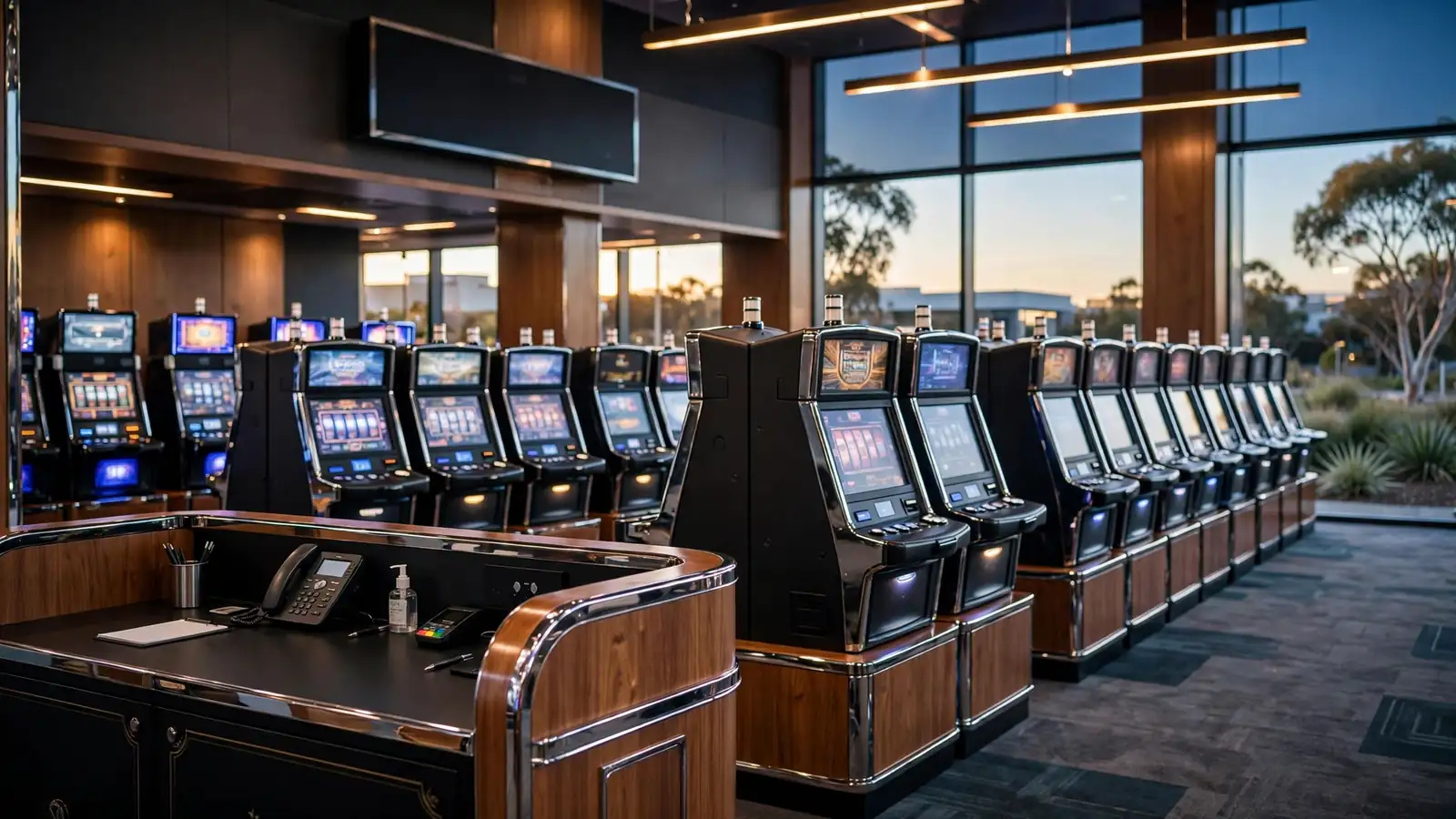
I have seen location language do more work than the underlying detail. “Close by” can be useful as a broad label, but without a confirmed address and a defined starting point, it says little about the actual journey. Airport searches are especially easy to misread: a result associated with the airport area need not be inside the airport, and a result shown nearby does not establish that it is suitable for someone travelling through it.
The distinction matters because search tools compress different kinds of information into one screen. A business label, a map marker and a short description may appear together, although they answer different questions. None, on its own, confirms a pokie floor, the machines available or the distance from a particular airport entrance. A polished listing is still a listing. Not a guarantee.
The same applies to searches that combine Brisbane with “near me” or the CBD. Those phrases depend on location context and the boundaries chosen by the service displaying the results. They do not create a consistent measure of distance, and they do not make a broad area label equivalent to a confirmed venue address. I would separate the location claim from the offer: first establish what place is being described, then whether the pokie claim is actually attached to it.
“Pokies in Brisbane Airport” is more specific in wording than “near the airport”, but the wording itself cannot confirm that machines operate inside the airport. Nor does a result connected with airport travel establish that a venue is within the terminal. The difference between “at” and “near” is not cosmetic; it changes the claim being made.
Age is a separate, clear condition. In Australia, gambling is restricted to people aged 18 or older, including play on pokies. That national minimum applies regardless of whether the setting is an airport, the CBD or another part of Brisbane. Location does not change eligibility.
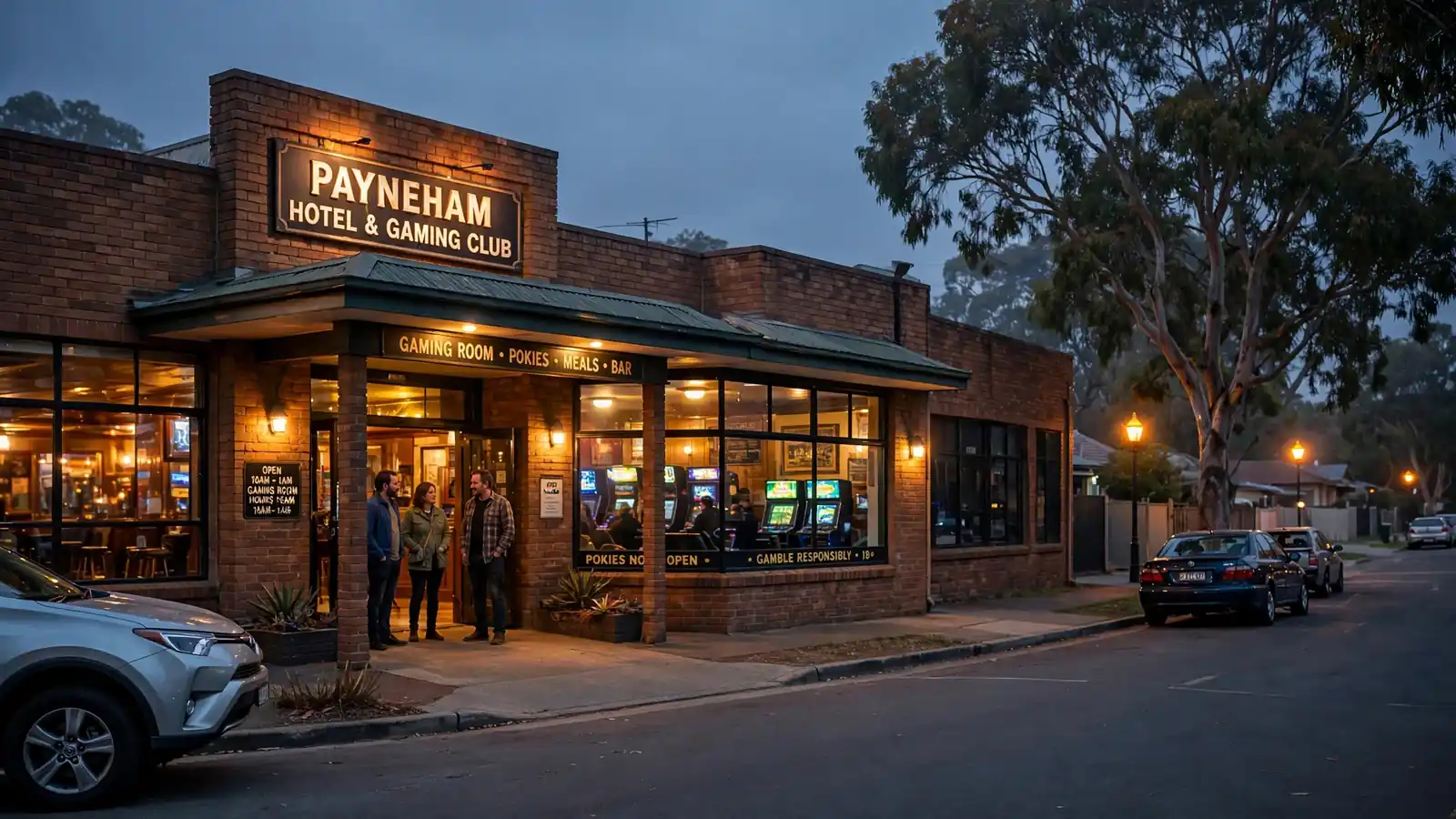
A useful way to read airport-area results is to treat each claim narrowly. A map result may indicate a location; it does not settle the venue’s offer or the exact distance. A phrase such as “near Brisbane Airport” should not be mistaken for confirmation that pokies are in the airport itself. The wording may sound convenient. The detail still has to carry the claim.
“24-Hour Pokies” and the Difference Between Search Terms and Venue Hours
“24-hour pokies” sounds like a straightforward description: machines available at any time, including late at night. In practice, that phrase is not an operating schedule. A venue’s hours and the hours when its pokies can run are matters of venue arrangements; a broad label cannot confirm either for a particular Brisbane location.
I learned to separate the wording on a sign or listing from the operational detail behind it. “Always open” is an advertising phrase, not proof that the doors are open at every hour or that machines are operating throughout. Opening times can also be mistaken for machine hours. They are not automatically the same thing.
So a claim about 24-hour availability should not be treated as a confirmed local fact. The same applies to an apparently current result: it may repeat a general description without establishing what is happening at the venue now.
There is a concrete staffing rule relevant to how machines operate. A report published by regionriverina.com.au describes a requirement taking effect from 1 July: venues with more than 20 gaming machines are to have a dedicated responsible gambling officer (RGO) on duty whenever those machines are running. That connects machine operation to the venue’s staffing arrangements; it does not say that venues must operate continuously, or that any Brisbane venue meets the threshold.
The distinction matters. A search for late-night pokies can mix together venue opening times, machine operation and general claims about availability. None can safely be inferred from the phrase “24-hour”. Even where a venue is open, that alone does not establish that pokies are operating at that time.
Attention: The phrase “24-hour pokies” is often an advertising term and does not guarantee that machines are operating at all hours or that the venue is open.
I would treat an exact schedule as a venue-specific detail, not something a city-wide label can supply. The responsible gambling officer requirement is likewise a condition tied to machine operation and venue size, not a promise of round-the-clock access. Until an actual operating schedule is confirmed directly with a venue, the “24-hour” wording remains just wording.
That is the practical limit. A search phrase can describe what someone wants to find; it cannot certify the hours.
South Brisbane and South Bank: No Verified Local Venue Guide
A South Brisbane or South Bank address is not enough to establish what pokies a venue has, how many machines it operates or what cash payout applies. The same is true of a Northside label. A map pin can help identify a place; it cannot, on its own, support a comparison between neighbourhoods.
I have seen how easily a listing turns a location into a promise. “Nearby” sounds useful, but it says nothing about a venue’s current offering or the terms attached to a particular machine. A venue name, machine count or payout figure needs direct, current confirmation before it can be treated as a local fact. Without that, a south-versus-north comparison would be guesswork dressed as guidance.
Maximum cash payout is especially easy to misread. It is not a single Brisbane-wide figure that follows from the words “pokies” or “South Bank”. A neighbourhood search cannot establish the payout conditions of an individual machine, and a headline number without a clear machine and venue context is not a sound basis for comparison. No shortcut there.
There is a separate operational detail worth distinguishing from location claims. A report by regionriverina.com.au says venues will be required to keep a gambling incident register, documenting occurrences that may indicate a patron is at risk of, or affected by, gambling harm. That record-keeping obligation concerns venue operations; it does not certify a local directory, identify a South Bank venue or tell anyone which machines are present.
From the counter side, the useful distinction is between a place being described by a suburb and a claim being supported by venue-level details. Those are not interchangeable. South Brisbane, South Bank and the Northside may appear in the same set of location results, but that does not make their venues comparable or establish that any one area has better machines or higher payouts.
For a local guide to be meaningful, each entry would need enough reliable detail to identify the venue and substantiate the specific claims being made. Otherwise, the polished format can create more certainty than the underlying information warrants. Location is a starting point, not evidence of machine choice, payout or performance.
A label is not a comparison.
Brisbane CBD Clubs and Pokies: What the Available Facts Leave Out
“Best” can sound like a settled verdict. In practice, a club’s location or label says little about how a particular pokie is configured, and it does not establish how it will perform. I have seen marketing language turn a broad venue category into a promise of quality. The wording is stronger than the evidence.
That matters for CBD clubs. A city-centre address does not, by itself, make one venue or machine a better choice than another. Nor does the word “club” tell anything reliable about machine numbers, game selection or returns. Those details need to be established for the specific venue and machine; a general description cannot fill the gap.
There is, however, an operational issue that is more concrete than a venue’s promotional language. A report published by regionriverina.com.au describes a requirement for venues to keep a gambling incident register. The register is intended to record occurrences, including situations where a patron’s behaviour indicates they may be at risk of, or experiencing, gambling harm.
That is a record-keeping measure, not a rating system. It does not show which club has the most machines, the best-performing games or a safer overall environment. Its relevance is narrower: it makes incidents and signs of harm part of venue operations rather than something that can be assessed from a venue name alone. Paperwork, not a promise.
Self-exclusion is another practical consideration for people trying to step away from pokies. It is a responsible-gambling tool, but the term does not describe a single process that can be assumed to work identically across every venue. The important distinction is between a venue-level arrangement and a broader exclusion service; the scope and effect depend on the arrangement in question. A label on a webpage is not enough to establish that scope.
I would separate three things that are often blurred together: where a venue is, what machines it offers, and what processes it has for responding to gambling harm. One does not prove the others. A CBD or club description may help identify a place, but it is not evidence of machine performance or of how an exclusion request is handled.
The useful standard is modest: treat promotional descriptions as descriptions, and operational claims as claims that need specific confirmation. A category is not a comparison.
Crown Brisbane Pokies: A Search Query Is Not Verification
The words “Crown” and “Brisbane” appearing together do not establish that a Crown casino, venue or pokie room operates in Brisbane. Nor does a result describing a “best” room prove that the place exists, has a particular selection of pokies or offers better play. Those are separate claims, and each needs evidence of its own.
I have seen how a recognisable name can do much of the work in a listing. It gives a place an air of familiarity before the practical details have been checked. But a brand reference is not a venue address, and a confident description is not confirmation of what is on a gaming floor. Without dependable venue information, it would be misleading to name a Crown location in Brisbane or describe its machines.
“Best” is another word that can hide several different judgments. It might mean a preferred style of game, a room’s atmosphere or a particular return setting. None of those meanings can be inferred from a venue name. A polished label, a familiar brand and a claim of superior play do not amount to a measurable comparison.
Return to player (RTP) figures need particular care. A specialist review reports that some game providers allow casinos to select among different RTP settings for the same pokie. That means a title alone may not establish which return setting applies at a particular venue. The relevant setting would need to be confirmed for that exact game and location; a figure associated with one version should not automatically be carried across to another.
Even a confirmed RTP is a long-run statistical measure, not a forecast for an individual session. Each spin is determined by a Random Number Generator and is independent of the previous spin. A run of losses does not make a win “due”, and a recent win does not make another one more likely. The machine does not remember.
That is the limit of what the name can tell. Without confirmation of a Brisbane venue and its specific game details, there is no sound basis for ranking a Crown pokie room or declaring its pokies the best. A recognisable label is not evidence.
Are online pokies legal for Australian players?
Yes, Australians can legally play on offshore sites that accept them, but companies cannot legally offer real-money online pokies to Australian residents without a domestic licence, and none have been issued. There is no Australian-licensed online casino, and players have no legal recourse in Australia if an offshore casino refuses to pay.
Are online pokies rigged?
Each spin is an independent random event determined by a Random Number Generator, so previous wins or losses do not predict the next result. The same game may also use different theoretical return settings at different casinos.
What does “wagering requirement” actually mean?
It is the amount you must bet, expressed as a multiple of the bonus or of the deposit plus bonus, before you can withdraw winnings. For example, a $500 bonus with a 40x requirement means $20,000 in bets; if the requirement applies to a $500 deposit plus a $500 bonus at 35x, it means $35,000 in bets.
Written by the editors at Malina Casino.