
Malina Casino KYC: Documents, Verification Time and Withdrawal Checks
 Available in US
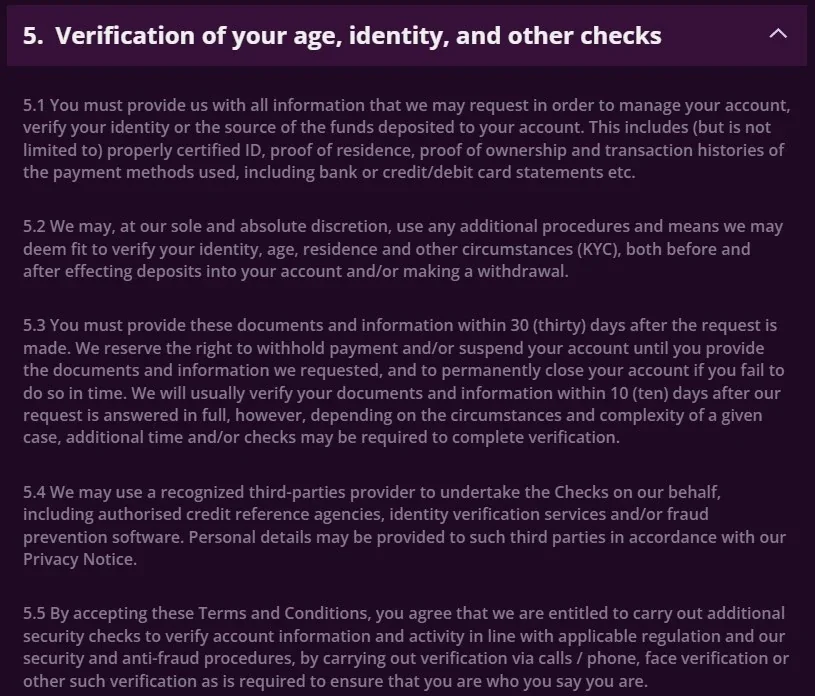
Malina Casino’s current General Terms allow the operator to request information and documents to verify a customer’s identity, age, residence, payment-method ownership and source of funds. The terms list certified identification, proof of residence, and evidence showing ownership and transaction history for payment methods among the material that may be requested. They also say documents are usually verified within 10 days after a request has been answered in full, while additional checks or more complex cases can extend that period.
This is not a promise that every account will need every document or that every case will finish in ten days. The wording matters because KYC can affect deposits, withdrawals and account access. Malina may conduct checks before or after deposits and around a withdrawal, and its terms allow payments to be held while requested verification is incomplete.
- What Malina’s KYC rules actually cover
- Document categories Malina may request
- How long verification can take
- Why payment-method ownership matters
- How KYC connects to withdrawals
- What can trigger additional checks
- What to do when Malina requests documents
- What to expect from verification
- How to read a verification request accurately
- Bottom line on Malina KYC
What Malina’s KYC rules actually cover
KYC is broader than showing an identity document. Malina’s terms describe checks used to manage an account and verify identity or the source of funds. They expressly refer to identity, age, residence and other circumstances, and they also connect verification with the payment methods used on the account.
That structure explains why a verification request can involve more than one category of evidence. An operator may need to establish who controls the account, whether the customer meets age requirements, where they reside, whether a card or bank account belongs to them, and whether the origin of deposited funds can be established. The important point is that the terms permit these checks; they do not say every customer will automatically receive the same checklist.
For the wider registration context, including the 18+ rule and account-information requirements, see the account guide. The sections below focus on the documents and timing rules that can become important once verification is triggered.
Document categories Malina may request
The current terms support a limited, specific set of document categories. They mention properly certified identification, proof of residence, proof that the payment method belongs to the account holder, and transaction histories connected with the payment methods used. Bank or credit/debit card statements are given as examples of supporting payment evidence.
Identity
A properly certified ID may be requested to establish the account holder’s identity and age.
Residence
Proof of residence may be requested to support the address or residence information linked to the account.
Payment ownership
Evidence that a bank account, card or other payment method belongs to the customer may be requested.
Payment history
Transaction histories or statements linked to the payment method may be requested where the operator needs to review account funding.
Source of funds
The terms allow Malina to request information needed to verify the source of deposited funds.
Document requests can vary by case. A passport, driving licence or identity card may appear in other parts of the terms, including refund-related procedures, but that does not mean every customer will be asked for the same KYC documents.
How long verification can take
Malina’s terms state that documents and information are usually verified within ten days after the customer’s response to the request is complete. The same clause immediately adds that more time or additional checks may be required depending on the circumstances and complexity of the case.
That distinction is central to interpreting the timing. The ten-day wording is a usual target measured from a complete response, not from the moment an account is opened and not necessarily from the first time a customer uploads one file. If additional information is requested, the process can continue beyond the usual period.
The terms also give the customer up to 30 days after a request to provide the requested documents and information. Failing to provide them within that period can lead to payment being withheld, account suspension and, under the terms, possible permanent closure. This makes responding fully to a verification request more important than trying to predict an exact completion date.
Why payment-method ownership matters
Malina’s account rules say that the credit/debit card or other payment method used to fund an account must belong to the customer. The KYC section then allows the operator to request proof of ownership and transaction histories for the payment methods used. Those provisions work together: the operator is not merely checking a name, but can also check whether the payment activity matches the verified account holder.
For a customer, this means a withdrawal review may involve evidence connected with the original deposit route. The precise evidence depends on the case. The terms support the possibility of ownership and transaction-history checks, but they do not justify claiming that every withdrawal always requires a bank statement or a photograph of a specific card.
Using payment methods in your own name and keeping account information consistent reduces obvious mismatches. It does not guarantee that no further KYC request will occur, because the terms allow additional checks both before and after deposits and withdrawals.
How KYC connects to withdrawals
Verification can directly affect payout timing because Malina’s withdrawal clauses allow the operator to delay a withdrawal while it checks identity, account balance, source of funds and compliance with the terms. Payments may be postponed until required verification procedures are completed.
Separately, the terms say withdrawal requests are worked through by the financial department within three business days once the applicable conditions are met and checks are complete. That makes the distinction between financial-department handling and KYC completion important. A three-business-day handling window should not be read as a guarantee that an unresolved verification case will be paid within three days.
The withdrawal guide covers the money-movement side in more detail, including the AUD withdrawal limits. Here, the focus is on the verification steps that can delay or condition the release of a withdrawal.
What can trigger additional checks
The terms give Malina discretion to use additional procedures to verify identity, age, residence and other circumstances before or after deposits and withdrawals. They also mention security checks relating to account information and activity and allow the use of recognised third-party verification providers, identity services and fraud-prevention tools.
Those clauses establish that verification can be risk-based rather than a single fixed step. They do not establish a public trigger list. It would therefore be misleading to claim that a particular deposit size, withdrawal amount, game pattern or device automatically causes KYC unless Malina publishes that rule.
A practical way to read the terms is that an account may move from routine use into a deeper review when the operator decides more evidence is needed. The customer then needs to answer the specific request received rather than rely on a generic checklist copied from another gambling site.
What to do when Malina requests documents
- Read the request carefully and identify each category of evidence being asked for.
- Provide information that matches the name and account details registered with Malina.
- Use documents that clearly show the information relevant to the request and are current where the request requires current evidence.
- If payment ownership is being checked, make sure the supporting evidence relates to the payment method actually used.
- Respond to any follow-up request rather than assuming the first upload completed the process.
- Keep copies of what you submit and any messages associated with the review.
Malina’s Help Centre also lists practical reasons documents can be rejected, such as poor image quality, expired identification, altered files or incomplete material. Those examples are useful for document preparation, but the formal document categories and timing on this page remain anchored to the General Terms.
What to expect from verification
The KYC sequence can differ between customers, and the stated ten-day timeframe is not a guaranteed completion time. A document that is sufficient in one case may not satisfy another request. Completing KYC is an account-control process and does not change Malina’s Australian regulatory status or create local regulatory protection.
For those questions, use the trust and licence guide. The distinction matters because successful identity verification proves that an account holder passed the operator’s checks, not that the service holds an Australian local licence.
How to read a verification request accurately
A useful KYC response starts by separating the operator’s formal request from assumptions about what a casino might normally ask for. If Malina requests proof of identity and payment ownership, answer those two points directly. If it also asks for residence or source-of-funds information, treat those as separate evidence categories rather than sending unrelated documents in the hope that one file covers everything.
The wording of the terms also makes completeness important. The usual ten-day verification period is tied to the point when the request has been answered in full. If one requested item is missing, unreadable or inconsistent with the account details, the practical clock can be affected because the review is not yet complete. That is why a clear, complete response is more useful than focusing only on the headline number of days.
Customers should also distinguish a request for information from a final decision. A request for extra evidence does not by itself establish wrongdoing, nor does it prove that a withdrawal has been refused. The terms allow additional checks as part of account and payment review, so the relevant question is whether the requested verification has been completed and whether any further information is outstanding.
Bottom line on Malina KYC
Malina can request evidence covering identity, age, residence, payment ownership, payment history and source of funds. The official terms say verification is usually completed within ten days after a request has been answered in full, while additional checks can extend the process. Customers are given 30 days to provide requested information, and unresolved verification can affect withdrawals or account access.
The most useful approach is therefore to treat KYC as a potentially multi-stage account review, respond to the exact request received, and separate verification timing from the separate three-business-day financial-department handling rule for withdrawals. Return to the Malina Casino Australia review for the wider product picture.
Published by the Malina Casino team.