
Online pokies with PayID in Australia: how it works
 Available in AU
PayID routes bank transfers through the NPP, while a pokies site’s cashier separately records whether funds have arrived.

- How PayID Moves Money to and from Pokies Sites
- Real-Money Deposits: Limits, Fees and the Point of No Return
- Checking Australian PayID Options Without Treating Them as an Endorsement
- What “Best” Means When PayID Is Only One Part of the Picture
- PayID Pokies Sites: Confirm the Cashier Before Signing Up
- The Small Print Behind PayID Deposits in Australia
- PayID Withdrawals: Approval Is Not the Same as Arrival
- Free Credits and the Conditions That Can Change Their Value
- Sites That Accept PayID: Check the Payment Route and Account Match
- Facebook PayID Pokies: Treat Payment Claims with Caution
How PayID Moves Money to and from Pokies Sites
PayID is an Australian bank-transfer service, not a casino account or a separate wallet. It links a bank account to a unique identifier, such as a mobile number or email address, so a transfer can be addressed without entering the recipient’s full account details. The New Payments Platform (NPP) carries the payment between participating banks.
That distinction matters when a cashier describes PayID as a payment option. The cashier is the site’s interface; the funds still move through a bank transfer. PayID supplies the route, while the site’s own account system records whether it has received a deposit or sent a withdrawal. The two systems connect, but they are not the same thing.
In a deposit flow, a site may present a PayID identifier for the transfer. The customer then uses their bank’s app or online banking to send money to that identifier. The bank routes the transaction through the NPP, and the receiving account gets the transfer. If the site’s payment process recognises the incoming funds, its cashier can reflect the deposit in the player balance.
That last step is separate from the bank transfer. A completed payment does not itself operate the site’s balance system; the operator must associate the incoming transaction with the relevant account. From the counter side, this was the point where a payment method’s apparent simplicity could hide a hand-off between two systems: the bank moves money, and the operator updates an account.
PayID can also be used in the other direction. A withdrawal request begins in the site’s account system. Once the operator sends the funds, the bank-transfer side routes them to the recipient’s PayID-linked account through the NPP. So the same payment rail can serve both deposits and withdrawals, even though the casino’s own steps differ between the two.
The identifier is the routing detail, not proof of who is behind the receiving account or what the site will do with funds. A bank transfer can identify where money is directed; it does not establish anything about the operator’s fairness, reliability or legal status. Payment branding can sound reassuring. The mechanism is narrower.

There is also an important Australian legal context. Under the Interactive Gambling Act 2001, it is illegal for operators to provide real-money online casino games, including pokies, to people physically located in Australia. PayID’s availability as a bank service does not change that rule or make a prohibited service lawful. The transfer system is general-purpose; its existence is not an approval of every business that might display it.
In practical terms, the phrase “PayID pokies” refers to a claimed connection between a bank transfer and an online casino cashier. It does not describe a special version of PayID. The bank handles the payment route, the operator handles its own account records, and the NPP connects the banks. Keeping those roles separate makes the mechanics easier to understand—and avoids mistaking a familiar payment method for an assurance about the service accepting it.
I have found that payment descriptions often compress these separate stages into one neat label. That is convenient copy, not a complete account of what happens. A transfer can be quick while the operator’s account handling remains its own process. Likewise, a withdrawal can use the same rail as a deposit without being controlled by the same workflow. The bank-to-bank movement and the site’s handling of a balance are distinct operations.

PayID is therefore best understood as the bank-transfer layer beneath a cashier option, rather than as a guarantee attached to a casino. It can move funds in either direction; it cannot decide whether the operator should be serving Australian customers in the first place.
Real-Money Deposits: Limits, Fees and the Point of No Return
A PayID deposit has two separate constraints: the minimum set by the payment menu and the transfer limit set by the bank. They are easy to confuse because both can stop a payment, but they are set in different places. The cashier’s minimum is the smallest amount an operator says it will accept; the bank’s limit governs how much can be sent through PayID. A payment that meets one condition can still fail the other.
Across operator payment menus, minimum deposits commonly begin at AU$10 to AU$20. A specialist gambling-payment review has also reported some sites setting a minimum at AU$5, but that is a narrower, changeable offer, not a dependable market-wide threshold. The amount shown in a cashier is the operative term for that particular service. A figure quoted in an old review or promotional panel may no longer match the live payment conditions.
Typical minimum deposits for PayID commonly range from AU$10 to AU$20, though some sites may offer a minimum as low as AU$5.
That minimum is not a recommendation about how much to deposit. It is simply a gate: below it, the cashier may not accept the transaction. The amount that appears small in a payment menu can still matter because PayID sends money from a bank account, rather than creating a separate balance with its own spending boundary. The decision to send should be made before opening the transfer screen, not while responding to a prompt to top up.
The bank’s daily PayID ceiling is a different control. A specialist payment review describes the sending bank as setting the daily transfer limit. The applicable setting can depend on the account and the bank’s rules, so a casino’s advertised minimum says nothing about how much the bank will permit to leave the account. If a transfer is declined, repeatedly changing the amount without understanding the bank’s restriction can turn a simple limit issue into a series of confusing payment attempts.
There is also a point of no return. Once a PayID transaction has been confirmed, it is irreversible. That matters more than the speed of the transfer: a rapid payment leaves little room to catch a mistake after confirmation. A mis-entered amount or a transfer made to the wrong recipient is not equivalent to a card payment that can simply be cancelled through the cashier. The confirmation step is the last practical pause before funds leave the account.
I have seen payment flows designed to make the final click feel routine. The amount is already entered, the recipient details are displayed briefly, and the next screen is framed as a formality. It is not. The bank confirmation is the point at which the sender commits the transfer. A cashier’s success message confirms that the payment route has responded; it does not provide a reversal mechanism.

PayID itself does not charge a transfer fee, and reputable venues do not add PayID deposit or withdrawal fees. That statement concerns the payment method and venue charges, not every possible cost attached to an account or service. The fee line, if any, should be read separately from the minimum and the transfer limit. A deposit can meet the amount threshold and still be subject to terms that are not part of PayID’s own payment charge.
The legal setting is essential to any discussion of real-money pokies in Australia. Under the Interactive Gambling Act 2001, providing real-money online casino games, including slots, to people physically located in Australia is illegal for operators. PayID is a bank-transfer method; its presence does not change that rule or make an online casino service lawful. Describing a payment route is not an endorsement of using it.
This distinction can get lost in the word “instant”. It describes the movement of money through a payment system, not the safety or legality of the service receiving it, and not a right to recover a confirmed transfer. Nor does a low minimum make a transaction less consequential. The same finality applies whether the amount is small or large.
In practical terms, the minimum answers whether a cashier will accept a deposit; the bank’s limit answers whether the account can send it; and confirmation determines whether it can still be stopped. Those are separate checks, not one promise of a smooth transaction.
Irreversible Payments
Once a PayID transaction is confirmed, it is irreversible; there is no mechanism to cancel or reverse the transfer through the cashier.
No undo button.
Checking Australian PayID Options Without Treating Them as an Endorsement
A PayID logo or payment claim is only a starting point. It does not show that a site can currently process PayID payments, that a transfer will work from a particular bank, or that the operator is trustworthy. I learned to separate those questions because payment labels are easy to display; the actual route depends on the operator’s live payment setup and the bank’s response.
A useful check is whether PayID appears as an available method in the site’s own payment information and account interface, rather than only in a banner or promotional claim. The details should be consistent across the pages describing deposits, withdrawals and account payments. If the method is described differently in different places, or the instructions lead to another payment route, the claim has not been established. A payment logo is not a working payment channel.
There is a further distinction between a site saying it supports PayID and a transfer being accepted by the bank. Some Australian banks may block transfers to gambling merchants under their acceptable use policies. A specialist review has reported such blocking by some banks, including major banks, but this should not be treated as a fixed or universal rule: bank policies and merchant controls can change. A declined transfer therefore does not, by itself, prove that the site’s PayID claim is false. Equally, a site’s claim cannot override a bank’s decision.
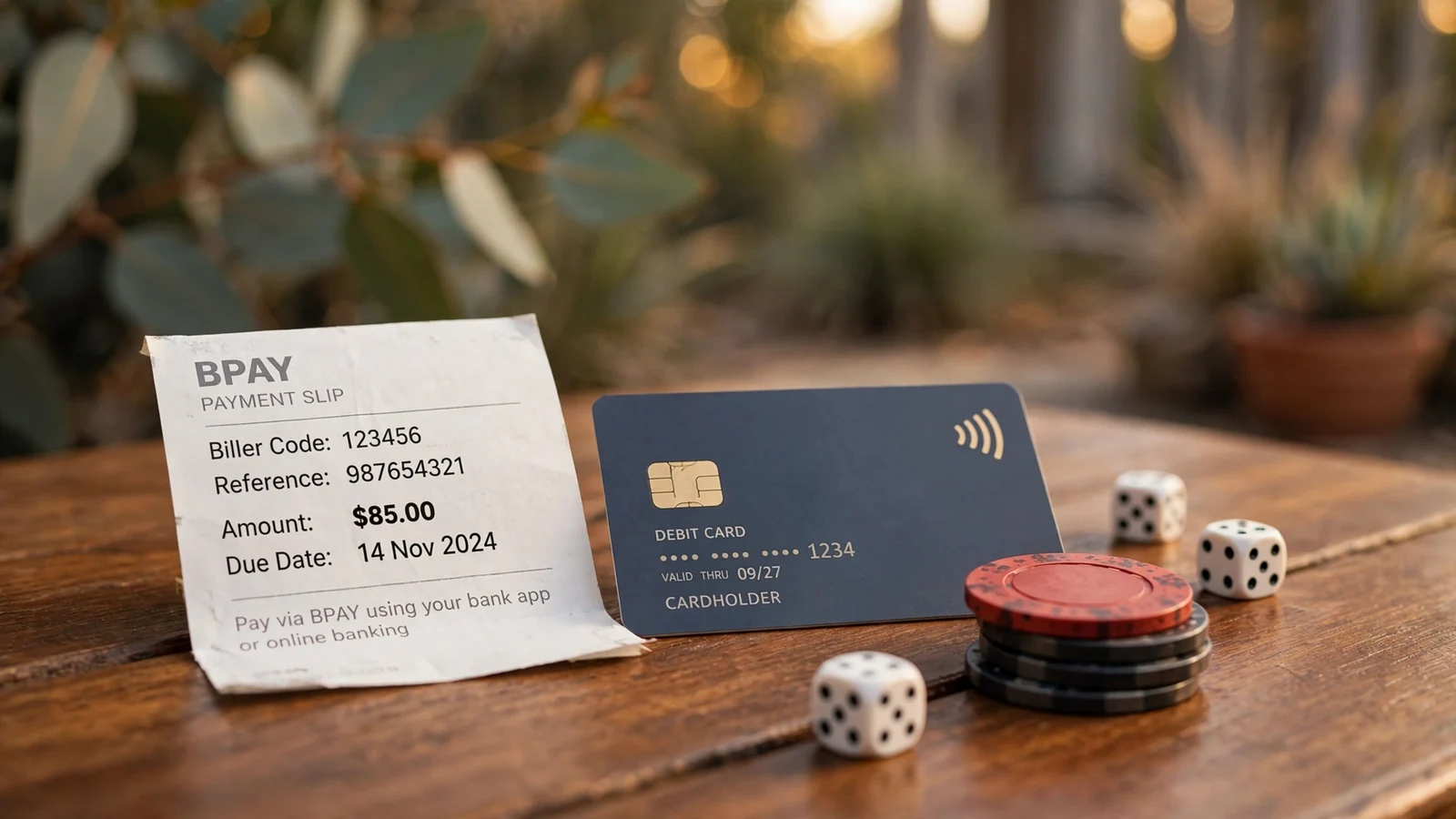
The payment details also need to correspond to the person’s bank-registered PayID. A mismatch can interrupt the payment route even where PayID is listed as an option. In practice, that makes the exact instructions important: the method should be presented as PayID, and the identifier used should be one registered with the bank. If the instructions instead request a transfer to unrelated details, the transaction should not be assumed to have the same protections or process as a PayID payment.
The larger issue is what a payment option can prove. Very little about the operator beyond the fact that a payment route is being claimed. PayID does not establish that games are fair, that return-to-player information is independently verified, or that withdrawals will be paid. Nor does the presence of a familiar Australian payment method establish that the business is authorised to offer gambling services to people in Australia.
That distinction matters because the law is not a small-print technicality. Under the Interactive Gambling Act 2001, providing real-money casino-style games, including pokies, to people in Australia is prohibited for operators. The payment method does not alter that position. A site serving Australian users does not become lawful because it offers a domestic transfer option, and an overseas licence, if claimed, is not an Australian authorisation to provide those services here.
I have seen payment branding do more persuasive work than it deserves. It can make an unfamiliar operator seem locally established, or make the process feel as though it has been checked by a bank. Neither inference follows. The bank handles the transfer; it does not certify the gambling service, assess the games, or guarantee the operator’s conduct. A successful payment is evidence only that a payment was accepted at that time.
- Check if PayID is in the actual payment interface
- Ensure PayID matches bank-registered details
- Verify the legal status of the operator
- Rely on banners or promotional logos alone
- Assume a bank transfer proves site fairness
- Mistake a payment method for legal authorisation
For an Australian-facing site, the assessment should therefore keep separate records of three things: whether PayID is actually offered in the site’s own payment flow, whether the bank permits the transfer, and what the legal status of the underlying service is. These are different checks, not interchangeable signs of credibility. A site can display PayID while a bank blocks a payment; a transfer can clear without proving anything about fairness or payout conduct; and neither event changes the legal restriction on offering online casino games in Australia.
That is why “Australian” in a payment description should be read narrowly. It may refer to the intended payment audience or the method being advertised, not to Australian ownership, local regulation or lawful access. The distinction is easy to blur in a sales page and costly to miss when real money is involved. Payment access is not endorsement.
What “Best” Means When PayID Is Only One Part of the Picture
For an Australia-focused search for online pokies with PayID, it helps to check the available operator details before choosing where to play. The notes below stick to the licensing, deposit and payout information provided; they do not confirm PayID availability.
Payout speed: crypto 30-120 minutes, fiat 24-72 hours · Min. deposit: A$30 MrPacho lists a A$30 minimum deposit. Its stated payout times are 30–120 minutes for crypto and 24–72 hours for fiat.
License: Curacao eGaming (Hollycorn N.V., since 2017) · Min. deposit: A$20-30 (depends on the offer) Playfina Casino is listed as licensed by Curacao eGaming through Hollycorn N.V. since 2017. Its minimum deposit is A$20–30, depending on the offer.
License: Curacao Gaming Control Board OGL/2023/174/0082 (Dama N.V.) SpinsUp is listed under Curacao Gaming Control Board licence OGL/2023/174/0082, held by Dama N.V.
License: Curacao Gaming Control Board JustCasino is listed as licensed by the Curacao Gaming Control Board.
License: Curacao eGaming OGL/2024/923/0383 (Antillephone N.V.) · Min. deposit: A$30 WinSpirit Casino is listed under Curacao eGaming licence OGL/2024/923/0383, held by Antillephone N.V. Its minimum deposit is A$30.
License: Curacao eGaming (Roby Games Ltd) Roby Casino is listed as licensed by Curacao eGaming, with Roby Games Ltd named in connection with the licence.
License: Curacao Gaming Control Board (TechSolutions Group N.V.) Bizzo Casino is listed under the Curacao Gaming Control Board, with TechSolutions Group N.V. named in connection with the licence.
License: Curacao · Min. deposit: A$20 (POLi) Lucky Dreams lists Curacao as its licensing jurisdiction. Its stated minimum deposit is A$20 when using POLi.
License: Curacao · Payout speed: crypto 30-60 minutes, fiat 1-5 days · Min. deposit: A$10 Wild Tokyo lists Curacao as its licensing jurisdiction and a A$10 minimum deposit. Its stated payout times are 30–60 minutes for crypto and 1–5 days for fiat.
License: Curacao – Antillephone N.V. (Versus Odds B.V.) · Min. deposit: EUR 20 Thor Casino is listed as licensed in Curacao by Antillephone N.V. (Versus Odds B.V.). Its stated minimum deposit is EUR 20.
“Best” is a sales label, not a payment feature. PayID can describe how a transfer is made; it cannot establish that an online casino is lawful, that its games are fair, or that it will pay winnings. I would keep those questions separate rather than letting a familiar payment logo do the work of a proper assessment.
There is a more basic issue for anyone in Australia. The Interactive Gambling Act 2001 makes it illegal for an operator to provide real-money online casino games, including pokies, to people physically located in Australia. A foreign licence does not change that position or create Australian authorisation. So a list presented as the best real-money PayID pokies sites for Australians risks making an unlawful service look like a normal consumer choice. I would not rank or recommend one.
That does not make the criteria behind the word “best” meaningless. It makes their order important. Payment access comes after the legal question, not before it. A site displaying PayID may be describing a transfer route, but that detail is not proof of local permission or a reason to treat the service as safe.

Separate the payment route from operator claims
When comparing payment terms in general, I look for statements that can be checked against the actual terms rather than promotional wording. A cashier listing PayID tells only what payment method the operator says it accepts. It does not establish the operator’s legal status, the fairness of its games, the clarity of its rules, or its willingness to honour a withdrawal.
The same distinction applies to words such as “trusted” or “secure”. They sound conclusive, but they need to be tied to verifiable information. A payment method cannot certify the business using it. Nor does a successful deposit prove that every later transaction or account decision will be handled as expected.
PayID does not impose a transfer fee of its own. A reputable venue should not add a separate charge just for using PayID to deposit or withdraw. That is a useful term to check, but it is only one part of the financial arrangement. It should not be mistaken for a broad guarantee that the operator’s other conditions are fair or clear.
Account details matter as well. The PayID used for a transaction needs to be the identifier registered with the player’s bank. A mismatch can complicate payment handling, so the payment instructions and account information should be treated as operational requirements, not as evidence of quality.
Attention A successful deposit does not guarantee that future transactions or account decisions will be handled as expected.
Treat “best” as a set of separate tests
In ordinary consumer comparisons, I would break a “best” claim into distinct questions: is the service legally available, are its terms understandable, and do the payment claims match what the cashier actually presents? Combining those into one score hides the most important distinction. A smooth payment route cannot compensate for a service that should not be provided in the market.
A licence claim also needs careful reading. The relevant question is not simply whether an operator displays a foreign licence, but whether the claimed authorisation can be independently verified and whether it permits the service being offered to people in Australia. Under the Australian legal framework, real-money online casino services are prohibited for operators to provide to people physically here. A foreign credential should not be presented as a local approval.
Payment terms deserve the same scrutiny, but for a different reason. A site may list a method while setting separate conditions for deposits, withdrawals, or account verification. Those conditions determine how the payment route works in practice; the label alone does not. If the terms are vague or conflict with the cashier information, that is a reason not to infer more than the available details support.
The point is not to turn a payment comparison into an endorsement. A table of methods or a “PayID pokies list” can appear neutral while directing people towards services that the law prohibits operators from providing in Australia. The format does not change the underlying issue.
What a responsible comparison can and cannot say
A careful comparison can explain what PayID does and what fees are stated. It can distinguish a payment claim from a claim about fairness, licensing, or payouts. It cannot turn payment availability into proof of legitimacy. That distinction is easy to lose when every option is presented as though the only question were which one is quickest or easiest.
I have seen how a convenient cashier option can dominate a first impression. It is a narrow signal. The stronger question is whether the service itself is lawfully offered to the person using it. In Australia, that comes before any attempt to identify the “best” real-money online pokies option.
So the phrase “best PayID pokies” should not be treated as a dependable verdict. At most, it describes a requested combination of a payment method and a type of gambling service. PayID can clarify the route a transfer takes; it cannot make a prohibited service lawful or turn an operator’s claims into independently established facts.
That is the distinction worth keeping. Payment feature, not endorsement.
PayID Pokies Sites: Confirm the Cashier Before Signing Up
A site’s payment page is the place to establish whether it actually lists PayID. A banner, promotional message or logo elsewhere on the site is not the same thing as a cashier option that can be selected. I treat the cashier as a description of the payment route the operator says it offers—not as independent proof that a transfer will work or that the operator is trustworthy.
There is a larger Australian context. Under the Interactive Gambling Act 2001, operators cannot lawfully provide real-money online casino games, including pokies, to people physically located in Australia. A page presenting PayID pokies as an available service does not change that position. Nor does a payment option establish that an operator holds a licence valid for this market.
Under the Interactive Gambling Act 2001, it is illegal for operators to provide real-money online casino games, including pokies, to people physically located in Australia.
If a cashier lists PayID, that tells only part of the story: the operator claims to accept that method. It does not certify game fairness, disclose how game outcomes are determined, or establish that winnings will be paid. Those are separate matters, and a payment logo cannot settle them. “Easy deposits” is a sales phrase. The cashier is a menu, not a guarantee.
I also separate the payment method’s own charges from anything a venue may add. PayID itself does not impose transfer fees, and reputable venues do not add a PayID fee for deposits or withdrawals. A fee shown in an operator’s terms should therefore be read as that operator’s condition, not assumed to be a PayID charge. The wording matters.
A careful check records what the cashier actually says: whether PayID is named, whether it appears for deposits, withdrawals or both, and whether the linked terms describe any operator-side conditions. If PayID is absent, a claim on another page should not be treated as confirmation. If the payment page is inaccessible until registration, that is not proof of availability either.
The label “PayID pokies” can make a payment feature sound like a seal of approval. It is not. In Australia, an operator’s willingness to display a payment method does not make a prohibited real-money casino service lawful, and it does not verify the operator’s identity, fairness or payout conduct. I would not turn a cashier listing into a recommendation or a list of supposedly approved sites.
A payment option answers one narrow question: what route the operator says it accepts. Nothing more.
The Small Print Behind PayID Deposits in Australia
A minimum deposit is set by the operator’s cashier, not by PayID itself. That figure is a condition of the payment route: it determines the smallest transfer the cashier will accept, while the bank applies its own controls to outgoing PayID payments. The two limits do different jobs.
A specialist review puts typical PayID minimum deposits at AUD 10–20, but that is a reported range, not a standard applying to every cashier. An operator can set a different threshold, and the amount shown may depend on the payment option selected. The cashier’s current terms are the relevant detail; a general description of PayID cannot establish what a particular site will accept.
There is another constraint at the bank end. A specialist review reports that the bank sets the daily PayID transfer limit. That limit can affect whether a payment goes through, regardless of the minimum shown by a cashier. The bank’s own rules therefore matter separately from the operator’s deposit conditions. No single figure can describe both.
From the inside, these figures are easy to confuse because they appear in the same transaction. The cashier minimum is an operator condition; the bank limit is a transfer control. One sets the lower boundary for an accepted deposit, the other can restrict the amount sent from the account. Neither changes what PayID is.
This distinction also matters when a page advertises a “low minimum”. That phrase describes only the operator’s stated entry threshold. It does not establish the bank’s limit, guarantee that a payment will be accepted, or say anything about the operator beyond that payment condition. Read the cashier wording as a narrow term, not a quality mark.
For Australians, there is a more important boundary around the subject: under the Interactive Gambling Act 2001, operators may not provide real-money online casino games, including pokies, to people physically in Australia. A listed PayID option does not alter that rule. The payment detail is not permission to use a prohibited service.
Deposit Limits
The operator sets the minimum deposit, while the bank controls the daily PayID transfer limit.
So the practical distinction is simple: the operator states its minimum, while the bank controls its PayID transfer limit. Separate conditions. Different sides of the payment.
PayID Withdrawals: Approval Is Not the Same as Arrival
A withdrawal has two separate clocks: the casino’s handling of the request and the transfer to the bank. In my experience, these are often blurred in payment descriptions. “Fast” may refer only to the PayID transfer after approval, not to the time between submitting a request and the casino releasing it.
The casino first reviews the withdrawal internally. Its checks and the account’s know-your-customer status can affect when the request is approved. If identity or account details still need checking, a request can remain under review; the payment method cannot speed up that stage.
Some specialist reviews describe casino-initiated withdrawals as having a pending period of 24–72 hours before funds leave the casino’s system. Treat that as a reported practice, not a standard that applies to every operator. A pending label means the request has not necessarily been sent to the bank. Approval and dispatch are distinct steps.
After approval, the PayID transfer itself is reported in specialist reviews as taking 12–24 hours. The same reviews put the overall journey from request to receipt at 2–4 days where an internal pending period applies. These are estimates, not a promise: the casino’s review and the account’s verification status remain part of the process.

That distinction matters when a status page says “processed.” The word may describe the casino’s action rather than confirmed arrival in the bank account. If a payment seems delayed, the useful detail is the stage shown in the account history: pending review, approved, or sent. Each points to a different part of the process.
I have seen payment language make the transfer sound like the whole story. It is not. PayID can move funds quickly once a casino has released them, but it cannot settle an unresolved internal review. Keep the request confirmation and status updates; they make it easier to identify whether the delay is still with the casino or comes after approval.
One further check sits before any withdrawal can proceed smoothly: the PayID details should match those registered with the bank, and the bank account name should match the casino profile. A mismatch can complicate the review rather than accelerate it.
The timing is conditional. Processing and arrival are not the same event.
Free Credits and the Conditions That Can Change Their Value
A “free credit” label describes a promotion, not money that can automatically be withdrawn. Its practical value depends on the attached terms: whether the credit must be played through, which games count, when winnings become withdrawable and what restrictions apply while the condition is being met. PayID’s presence in a payment menu does not change those rules or confirm that a promotion is genuine.
A specialist review has reported wagering requirements of 30x–45x the bonus amount. That range should not be treated as a fixed market rule; the terms for a particular offer are what govern it. The wording matters. A requirement may apply to the bonus, rather than the combined balance, and exclusions can limit which play contributes. A headline figure alone leaves out the conditions that determine whether the credit has any usable value.
Exceeding the maximum stake during bonus wagering can void the bonus and any associated winnings.
The maximum-bet clause deserves particular attention. If the terms set a maximum stake during bonus wagering, exceeding it can void the bonus and winnings associated with it. The restriction may apply only while the bonus is active, but that distinction must be explicit in the offer terms. A promotional balance can disappear because of a single breach. No drama. Just a clause enforced.
I have seen “free” do a lot of work in promotional copy. In practice, it often means conditional credit, not a no-strings cash amount. A PayID label beside an offer says nothing about its wagering rules, and a social post repeating the claim does not replace the written terms. Australian law prohibits operators from providing real-money online casino games to people in Australia, so promotional language should not be read as an invitation or assurance that such play is lawful.
Sites That Accept PayID: Check the Payment Route and Account Match
A payment logo or claim on a landing page is not enough to establish that PayID is available for a particular transaction. The relevant check is the cashier’s payment menu: it should identify PayID as an option and show the route and details required for payment. Menus can differ from general promotional copy. I treat the cashier as the operative instruction, not a banner.
That check is about the payment route only. PayID availability does not establish that a site is lawful, fair, transparent about game returns or willing to pay winnings. In Australia, the Interactive Gambling Act 2001 prohibits operators from providing real-money online casino games to people physically in the country. A site’s payment menu does not change that position.
A mismatch can cause trouble even where PayID is displayed. The PayID used for a transfer must be the one registered with the player’s bank. The bank account name should also match the name on the casino profile; different details can complicate a later withdrawal or account review. Small discrepancies matter. Payment systems match records, not intentions.

Before any payment, the destination and recipient details should correspond to the instructions in the cashier. A request to send funds to an unrelated identifier, or to use details supplied outside the stated payment flow, is a reason to stop rather than improvise. A successful transfer confirms only that money moved through the payment system. It does not validate the operator or resolve a mismatch in account records.
The useful distinction is narrow: a cashier can show whether PayID is offered, while matching details reduce the risk of a payment being credited to the wrong account. Neither makes an Australian real-money pokies service lawful.
Facebook PayID Pokies: Treat Payment Claims with Caution
A Facebook post that mentions PayID is making a claim about a payment route, not proving that the account behind it is genuine, that an offer is real or that anyone will receive a payout. The distinction matters: PayID is a transfer method, not a test of an operator’s identity or conduct.
I have seen payment language do a lot of work in promotional copy. A familiar bank-transfer option can make an unfamiliar page feel more credible, while leaving the important questions unanswered: who controls the account, where the money is going and what happens after it is sent. A logo or confident caption settles none of them.
Once a PayID transfer is confirmed, it cannot be reversed through the payment system. That makes a social-media claim particularly poor grounds for sending money. A conversation in comments, a private message or a screenshot of a supposed successful payment is not independent confirmation; each can be presented without establishing who is behind the account.
There is also a legal issue beyond payment reliability. Under Australia’s Interactive Gambling Act 2001, providing real-money online casino games to people in Australia is illegal for operators. A Facebook post does not change that position, and PayID availability does not make the service lawful or trustworthy.
The practical reading is simple: treat claims about Facebook pokies and PayID as unverified, not as an endorsement or assurance. The payment method can move funds; it cannot verify the person asking for them. Once confirmed, the transfer is final.
How do I deposit money into an online casino using PayID?
If a cashier offers PayID, it provides an identifier for the transfer. Send the money to that identifier through your bank’s app or online banking; once the operator matches the incoming payment to your account, it can update your balance.
What is the minimum amount I can deposit into casino sites using PayID?
Most operators set PayID deposit minimums at A$10–A$20, while some accept deposits from A$5. Check the cashier for the current minimum, and remember that your bank’s transfer limit is a separate restriction.
How long do PayID withdrawals take?
After the casino approves a withdrawal, the PayID transfer usually arrives within 12–24 hours, often on the same day. The casino may first hold the request for review, making the total time from request to receipt typically 2–4 days.
What is the minimum PayID deposit?
Most operators set the minimum at A$10–A$20, though some accept A$5. The cashier shows the applicable minimum for that service.
Can I play pokies using PayID?
PayID can be used as a bank-transfer method for deposits and withdrawals, but it is not a way to play games. Under Australia’s Interactive Gambling Act 2001, operators cannot provide real-money online casino games, including pokies, to people located in Australia.
Published by the Malina Casino team.