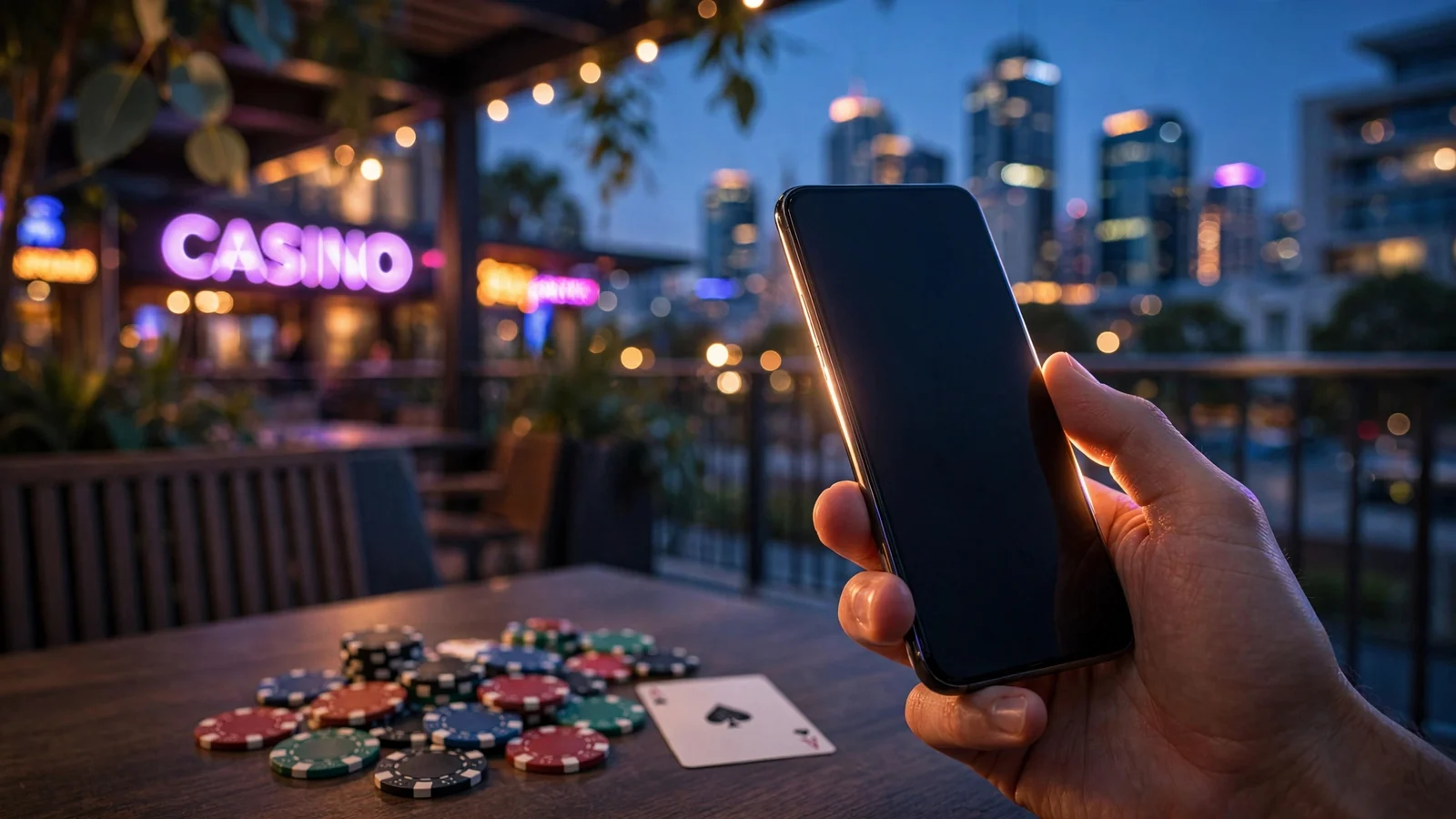
Casino apps for Android in Australia: what to know
 Available in AU
A guide to browser play, app installs, free pokies and the limits of offshore real-money casino access in Australia.

- The Australian rules behind online casino access
- Online casino access on Android usually means browser play
- Native apps, PWAs and the risks of installing outside an app store
- Free Android pokies are a different kind of casino app
- Real-money slots on Android: the offshore boundary
- Android slot games and the connection problems behind a stalled session
- Casino apps for Android: what the format comparison leaves out
- Bonuses, wagering requirements and the deadline behind the offer
- Deposits and withdrawals on a mobile casino account
- Android casino games: account checks and safer-play controls
The Australian rules behind online casino access
An Android search can make an online casino look like an ordinary app choice. The legal position is different. Under the Interactive Gambling Act 2001, operators must not provide online casino-style gambling to people in Australia. That prohibition covers services offering casino games to customers here; it is not a question of whether the service is packaged as a website or presented as an app.
The distinction is between the operator’s conduct and an individual punter’s position. The Act does not make it illegal for an Australian player to access an offshore mobile casino. That does not mean the service is authorised in Australia, approved by a local regulator or protected by Australian consumer safeguards. Nor does it make an offshore casino a recommendation. I have seen the wording around “available in Australia” used as if availability settled the legal question. It does not.
The Australian Communications and Media Authority (ACMA) enforces the rules against prohibited gambling services and can arrange for illegal gambling sites to be blocked. A blocked page may therefore reflect regulatory action, not merely a fault with an Android device or an app. Blocking is one part of enforcement; it does not turn an offshore operator into a locally approved provider if its site remains reachable by another route.
Choosing an Android casino app in Australia calls for checking the practical details available for each operator, such as payment terms and licensing information. Use these short verdicts as a starting point when deciding what to investigate further.
Payout speed: crypto 30-120 minutes, fiat 24-72 hours · Min. deposit: A$30 MrPacho lists crypto payouts at 30–120 minutes and fiat payouts at 24–72 hours. The minimum deposit is A$30.
License: Curacao eGaming (Hollycorn N.V., since 2017) · Min. deposit: A$20-30 (depends on the offer) Playfina Casino is licensed by Curacao eGaming through Hollycorn N.V., with the license noted as active since 2017. Its minimum deposit is A$20–30, depending on the offer.
License: Curacao Gaming Control Board OGL/2023/174/0082 (Dama N.V.) SpinsUp is licensed by the Curacao Gaming Control Board under OGL/2023/174/0082, held by Dama N.V.
License: Curacao Gaming Control Board JustCasino is licensed by the Curacao Gaming Control Board.
License: Curacao eGaming OGL/2024/923/0383 (Antillephone N.V.) · Min. deposit: A$30 WinSpirit Casino is licensed by Curacao eGaming under OGL/2024/923/0383, held by Antillephone N.V. Its minimum deposit is A$30.
License: Curacao eGaming (Roby Games Ltd) Roby Casino is licensed by Curacao eGaming, with Roby Games Ltd listed as the license holder.
License: Curacao Gaming Control Board (TechSolutions Group N.V.) Bizzo Casino is licensed by the Curacao Gaming Control Board, with TechSolutions Group N.V. listed in connection with the license.
License: Curacao · Min. deposit: A$20 (POLi) Lucky Dreams is licensed in Curacao. Its minimum deposit is A$20 when using POLi.
License: Curacao · Payout speed: crypto 30-60 minutes, fiat 1-5 days · Min. deposit: A$10 Wild Tokyo lists crypto payouts at 30–60 minutes and fiat payouts at 1–5 days. It is licensed in Curacao, and its minimum deposit is A$10.
License: Curacao – Antillephone N.V. (Versus Odds B.V.) · Min. deposit: EUR 20 Thor Casino is licensed in Curacao through Antillephone N.V. (Versus Odds B.V.). Its minimum deposit is EUR 20.
For anyone weighing up an Android casino app or a mobile site, the central point is that access and authorisation are not the same thing. A service may appear on a phone, yet still fall outside the lawful services operators can offer to people in Australia. Equally, the fact that an individual player is not committing an offence under this Act does not amount to a government endorsement of the operator or a guarantee about what happens in a dispute.
That distinction is easy to lose in app-style marketing. “Australian access” describes a technical possibility, not a local licence or official approval. The law targets the provider’s offer, while ACMA’s blocking activity can affect whether a site is reachable. Different questions. Different consequences.
Online casino access on Android usually means browser play
An Android phone can reach a casino-style website without a dedicated application. In practice, browser access is the usual arrangement for offshore operators that accept Australian users: the site opens in Chrome or another mobile browser, and the punter signs in with the account used on a desktop computer. The screen is adapted to a smaller device, but the account itself is not a separate “mobile” account.
That distinction matters. A browser session is generally another way into the same account, not a separate product with its own balance or identity. A deposit or account change made on one device may therefore be visible when the same account is opened elsewhere. I have seen operators describe this as “seamless”; what it really means is that the account record sits with the operator, while the phone supplies the screen and connection.

The layout can change between desktop and Android. Menus may collapse, account controls may move, and a game may load in a different frame. Those are interface choices, not evidence that a separate Android account is required. If a login page asks for registration again after a desktop account has already been created, that is a point to resolve with the operator before any transaction, rather than a reason to create duplicate profiles.
Browser access is also why the phrase “casino app” can mislead. In ordinary use, people may call a saved website or a mobile-friendly page an app even when it is running in the browser. The exact distinction between a native application and a browser-based shortcut is a separate format question. Here, the practical point is simpler: Australian mobile access is commonly a website opened on Android, with the same account credentials as desktop.
Offshore operators are not a single category with one common rulebook. Jurisdictions associated with operators that accept Australians include Curaçao, Malta and Gibraltar. A foreign jurisdiction named on a website does not make the service locally authorised, nor does it establish that a particular operator will accept a person in Australia. The operator’s location policy can change, and it may reject access from a particular place even if the site itself loads.
Attention: A page that opens on a phone is not confirmation that an account can be registered, funded or paid out from Australia.
That is why location acceptance must be confirmed before depositing. A page that opens on a phone is not confirmation that an account can be registered, funded or paid out from Australia. Terms may distinguish between being able to view a site and being eligible to use its services. The distinction is consequential. Confirm first; do not infer eligibility from a working browser page.
Some offshore operators are crypto-friendly, but that label describes a payment orientation, not a guarantee of access, reliability or withdrawal. It is not an endorsement. The same caution applies if the site presents itself as mobile-ready: a polished Android interface does not settle questions about account conditions or the ability to recover funds. If an offshore casino withholds winnings, there is no Australian government body for a local punter to complain to and obtain that money through.
I have seen the smoothness of the first login carry more weight than it deserves. A page can open quickly and remember a session, while the difficult questions remain buried in terms or account rules. Browser convenience is a narrow fact about access. It should not be mistaken for local oversight or a remedy if a dispute arises.
There is also a practical risk in trying to make a blocked site appear reachable. Using a VPN to access a casino that is blocked may breach its terms; the operator may void winnings or close the account. A changed connection route does not remove the operator’s location rules, and it can make an account review harder to resolve. Convenience can become evidence against the account.

The useful mental model is therefore modest: Android browser play is often the same account, viewed through a smaller screen. It explains how access works, not whether an offshore service is safe, suitable or entitled to serve someone in Australia. A working login is not a safeguard.
Native apps, PWAs and the risks of installing outside an app store
On Android, “app” can describe quite different things. A native app is software installed on the device, while browser access keeps the service in a mobile website. A Progressive Web App (PWA) sits between those formats: it is a shortcut to a website that opens and behaves in a way that resembles a native app. The distinction matters because an icon on the home screen does not, by itself, prove that a separate app has been installed.
In practice, browser play remains the standard route for casino services aimed at Australians. These services are seldom found in Google Play, so an Android user may reach the website through a browser rather than download an app from the store. A PWA can make that route feel more app-like without changing its underlying connection to the website.
The installation process is handled from the site itself. If it offers an install or add-to-home-screen prompt, tapping it and confirming adds the shortcut to the device. The exact wording may vary, and not every site presents the option. The important point is that a PWA begins as a website; installing its shortcut does not turn it into a store-verified native application.
A Progressive Web App (PWA) is a shortcut to a website that behaves like a native app but remains a website at its core.
That distinction is easy to blur in promotional language. “App-like” describes the way the shortcut behaves on a phone, not an independent guarantee of quality, security or support. I have seen format labels do a lot of work in marketing while leaving the actual delivery method unstated. Check what is being installed. Small distinction. Real consequence.
A native Android package offered outside Google Play is often called a sideloaded app. Installing one means getting software through a route outside the usual store listing and its review process. That creates security risks: the package could be unsafe, and its reliability depends on the operator supplying and maintaining it. A familiar-looking icon or download button is not evidence that the file is trustworthy. If an operator provides an app this way, the risks do not disappear because the service calls it official.
A PWA avoids downloading a separate application package, but it still relies on the casino website and the operator behind it. It should not be treated as proof that the service is secure or suitable. The choice is therefore not simply between a “real” app and an inferior browser. Browser access and PWAs are common formats; a sideloaded package adds a separate software-installation risk.
Offshore crypto-friendly casinos may offer these formats, but that description is not an endorsement. Location acceptance must be confirmed with the operator before any deposit; a site being reachable on a phone is not confirmation that it accepts an Australian user. There is also no Australian government body to complain to if an offshore casino withholds winnings. That is a significant practical difference, not a technical detail.

A VPN does not make a blocked casino app or website a safer installation. Using one to reach a blocked casino may breach the operator’s terms and can result in winnings being voided or the account being closed. The VPN may alter the apparent connection location, but it does not change the operator’s decision about account access. Risk remains.
For Android, the format check is straightforward: identify whether the service is a browser site, a PWA shortcut, or a separately downloaded package. Do not infer safety from the word “app,” and do not treat an installation prompt as independent verification. The label is not the safeguard.
Free Android pokies are a different kind of casino app
The word “free” can make two different products sound alike. In one, an Android app uses virtual credits for social or free-play casino games. In the other, the activity involves staking money for a possible cash return. The shared visual language—spinning reels, familiar casino-style interfaces and a balance displayed on screen—does not make the products equivalent.
Social and free-play casino apps that use virtual credits are available directly through the Google Play Store and Apple App Store, and they are legal to use in Australia. That describes the app format and its credits; it does not turn those credits into money. They are not a withdrawable balance, and a result shown in the app is not a cash prize.
Virtual credits in free-play apps have no cash value and cannot be exchanged for money.
I have seen the word “winning” do a lot of work in this category. In a free-play app, it can mean that the score or virtual-credit balance has changed. It does not, by itself, mean that money has been won. The distinction is easy to miss when the interface resembles a real-money product, but the label on a screen cannot change what the credits represent.
That is why “free” needs to be read literally and narrowly. It refers to play with virtual credits, not a free route into cash gambling and not a promise that credits can later be exchanged for money. An app may present casino-style play as entertainment or social activity; its internal balance remains part of that experience. No cash value follows from the balance merely because the app uses casino imagery or keeps a score.
A search for Android casino-style games can therefore lead to apps that are genuine native downloads without being real-money gambling products. Their presence in an app store is not evidence that a user can deposit, wager cash or withdraw winnings. Store availability and the presence of real-money play are separate questions. The useful distinction is the role of the credits, not how closely the graphics resemble a casino.

The same caution applies to descriptions such as “slot machine app” or “online slots.” Those labels may refer to free-play entertainment, while a real-money product is a different category altogether. For a free-play app, the practical reading is straightforward: virtual credits stay virtual. They are not a payment method, a prize balance or a claim on money.
I used to treat a familiar interface as a shortcut for understanding what sat behind it. That was a mistake. The interface tells very little about whether an app handles money; the credit model tells more. Where an app is explicitly based on virtual credits, the sensible expectation is entertainment within the app, not a cashout.
This distinction also prevents a common category error: calling every casino-style app a gambling app, or assuming every app-store download offers real-money play. Free-play apps and real-money gambling are not interchangeable simply because both use casino themes. One has virtual credits; the other involves money. That is the dividing line.
Real-money slots on Android: the offshore boundary
A search for real-money pokies on Android can suggest that a locally authorised casino app is waiting to be downloaded. That is not how the Australian market is structured. The Interactive Gambling Act 2001 prohibits operators from offering real-money online casino games to people in Australia, so services presenting these games to Australians are offshore, not locally authorised Android casinos.

That distinction matters more than the label on an app or website. Offshore services may be crypto-friendly, but that does not make them Australian-regulated or endorsed. I have seen how a polished mobile interface can make the operator’s location feel like a minor detail. It is not. Offshore operators are also subject to ACMA blocking, which can affect access.
Age is a separate threshold: a person must be at least 18 to register and gamble in Australia. Meeting that requirement does not change the status of the service or create local consumer protection. If an offshore casino refuses to pay winnings, there is no Australian government body to complain to for recovery. A VPN used to reach a blocked casino may breach its terms, void winnings or lead to account closure. Access can disappear. So can the account.
Before any deposit, the operator’s terms need to confirm that it accepts customers located in Australia. A site being visible, or accepting a particular payment method, is not proof that the location is permitted. This is especially important where the service’s own restrictions differ from the country list displayed in marketing material.
The account mechanics can also affect cashout. A specialist review reports that some casinos require a withdrawal through the same method used for the deposit, while other methods are deposit-only. That can make a payment option convenient at the start but unusable when funds are requested. The withdrawal rules should be checked before an account is funded, not after a balance has accumulated.
Withdrawal ceilings are another condition worth reading carefully. A specialist review describes some operators as setting weekly or monthly caps, with reported weekly limits in the $4,000–$10,000 range. Those figures are not a universal rule: the applicable cap depends on the operator’s terms, and the timing of payments can matter as much as the nominal balance. A large displayed balance does not necessarily mean the full amount can be withdrawn at once.
I treat the cashier page and withdrawal terms as part of the same account decision. The deposit route, any deposit-only methods, the required withdrawal route and the applicable cap all belong in that check. None of this turns an offshore service into a local one. It simply makes the practical boundary harder to miss.

Android slot games and the connection problems behind a stalled session
A session that freezes on an Android phone is not necessarily a problem with the game itself. A specialist review identifies weak connectivity, limited available memory, an outdated browser and too many apps running in the background as common causes of mobile casino trouble. Each can interrupt loading or leave the screen unresponsive, and several can occur at once.
Connection quality is often the first thing to check. A signal that appears present may still be unstable, particularly when moving between networks or using a crowded public connection. If a game stops responding, repeatedly tapping controls can make it harder to tell whether the page is still processing. Waiting for the display to update, then checking whether other pages load, helps separate a local connection problem from a stalled session.
Memory affects how much work the phone can handle at once. A device with little free memory may struggle when a browser has several open tabs or other demanding apps remain active. Closing unused tabs and background apps can free up resources. If the browser itself has become sluggish, closing and reopening it may help; restarting the phone is another basic way to clear a temporary slowdown.
An old browser can cause different symptoms: a page may load only partly, controls may fail to respond, or the session may stop during play. Keeping the browser and Android software current reduces the chance of running into compatibility problems, though it cannot correct a weak network or limited device capacity. Clearing a browser’s stored data may help with a persistent loading fault, but it can also sign the user out or remove saved site settings.
The sequence matters. Check the connection first, then close unnecessary apps and tabs. If the issue persists, reopen the browser and see whether its software is current. This avoids changing several settings at once and losing track of what made a difference. If only one site continues to fail while other pages work, the cause may be on the site’s side rather than the phone.
A stalled screen also leaves uncertainty about whether an action registered. Avoid repeating a payment or other account action until its status can be checked through the account or the operator’s support channel. A technical interruption is not evidence that a transaction failed or completed.

These checks address performance only; they do not establish whether a service is lawful or safe. Offshore crypto-friendly casinos are not endorsed here. Their location acceptance must be confirmed before any deposit, and using a VPN to reach a blocked casino may void winnings or result in account closure. If an offshore casino withholds winnings, there is no Australian government body to complain to.
Casino apps for Android: what the format comparison leaves out
The app-store picture is not uniform. In Australia, Google Play and Apple’s App Store do carry social and free-play casino apps that use virtual credits. Their presence on those platforms does not mean that real-money casino services are available through the same route.
Real-money casino apps are rarely found in the Australian stores. In practice, that leaves a different impression from browsing a store catalogue: a person looking for an Android casino app may see plenty of casino-themed products, but those may be designed for play with virtual credits rather than cash. The word “casino” describes the theme, not necessarily the payment model.
I have seen that distinction blur when an app’s name, screenshots or store description lean heavily on casino language. The useful detail is how the product handles credits and whether they can be converted into money. For free-play apps, virtual credits are for use within the app; their availability in an official store does not make them a route to cash gambling.
A real-money service operating outside the stores is a separate matter. Offshore crypto-friendly casinos may offer Android access through a website rather than a downloadable store app, but that is not an endorsement or recommendation. Australian punters should confirm that a site accepts their location before making any deposit. Using a VPN to reach a blocked casino may result in winnings being voided or an account being closed. If an offshore casino refuses to pay, there is no Australian government body to complain to on the punter’s behalf.
That is the gap a format comparison can miss: store availability tells little about what kind of product is being presented, while an app-store listing is not a guarantee of suitability or safety. The name and appearance can be similar; the way the credits work is not.
A store catalogue is not a licence. Nor does a browser-based service become a local product simply because it works on Android. The format is only one part of the distinction.
- Check the credit model of the app
- Confirm location acceptance before depositing
- Distinguish between PWA and native apps
- Infer safety from store availability
- Use a VPN to bypass blocked sites
- Assume a “casino” theme means real money
Bonuses, wagering requirements and the deadline behind the offer
A bonus headline leaves out the conditions that determine whether the offer has practical value. The amount displayed is only one part of the calculation: wagering requirements, any minimum deposit, the games that count and the time allowed to meet the requirements all matter. A specialist affiliate review describes welcome-bonus wagering requirements in the 30x–50x range, and characterises requirements above 40x as steep. These are reported figures, not a promise that a particular offer will use them; the written terms for that offer are what count.
A wagering multiple sets the amount of qualifying bets required before bonus funds, or winnings linked to them, can be withdrawn. The base matters. A multiple applied to the bonus alone creates a different requirement from one applied to the deposit and bonus together. Terms can also limit which games contribute, or count some games differently. A headline without its calculation basis is incomplete.
Then there is the deposit threshold. If an offer requires a minimum deposit, that amount is part of its cost, not a footnote. A punter who deposits only to qualify may find the bonus adds conditions without adding useful flexibility. The sensible comparison is between the amount that must be deposited, the wagering still required and the restrictions on cashing out. No attractive wording changes that arithmetic.
Time limits can make the calculation less favourable. A specialist affiliate review reports that many bonuses have to be cleared within 7–10 days; if the deadline is missed, the bonus is lost. The clock may start at a point set out in the terms, so the expiry date should be checked rather than inferred from the day an offer was noticed. A tight window can turn a large wagering task into an impractical one. Deadline first.
Before accepting any offer, the terms should be read for the wagering requirement and its base, minimum deposit, game restrictions, expiry date and cashout cap. A cashout cap can limit what is withdrawable even after the wagering is complete. Conditions may also state what happens to bonus funds and related winnings when a deadline passes. If any of these details are unclear, the offer cannot be assessed reliably. “Free” is a label, not a description of the conditions.
This is especially important in Australia, where real-money online casino services are prohibited for operators to provide. Offshore crypto-friendly casinos may publish bonuses, but this is not a recommendation or endorsement. An offshore operator’s location terms must be checked before any deposit; using a VPN to reach a blocked casino may void winnings or result in account closure. If an offshore casino withholds winnings, there is no Australian government body for a punter to complain to.
So the useful question is not whether a bonus looks generous, but whether its full terms are clear and whether the requirement, deposit and deadline make sense together. If the terms cannot be checked before accepting it, the headline is not enough. No shortcut.
Deposits and withdrawals on a mobile casino account
A payment option shown on a deposit screen does not necessarily work in reverse. Some methods are deposit-only, while some casinos require a withdrawal to return through the method used to fund the account. The distinction matters before a transaction is made: a successful deposit does not establish that the same route can receive a payout.
POLi is no longer a working local option. Its Australian operations ended in September 2023, so a page that still presents POLi as available may be out of date. PayID is a separate service. One specialist review describes PayID deposits as near-instant and typically free, but that is the review’s report, not a guarantee of the timing or fee on a particular account.
Card deposits can fail for reasons outside the casino’s payment screen. Some Australian banks block or flag gambling-related card charges, according to specialist reviews, so a declined transaction may reflect the bank’s policy rather than an input error. Credit cards must not be accepted for online gambling services.
E-wallets such as MiFinity, Skrill and Neteller can be used for deposits and withdrawals, though the available routes depend on the account. Specialist reviews report that e-wallet withdrawals may arrive within 24 hours after the casino’s pending period; the pending stage is separate from the time taken by the payment provider. The distinction is easy to miss. Two clocks.
Bank transfers take longer. Specialist reviews report that a withdrawal can take up to five business days, with processing time affected by the casino’s own handling and the banking route. A displayed estimate should therefore be read as a timeframe, not a promise of arrival.
For a real-money casino account accessed on Android, the payment page is only one part of the process. Deposit and cashout methods, fees, processing stages and any same-method rule should be checked in the account terms before money is moved. A list of logos is not a payout policy.
Android casino games: account checks and safer-play controls
The account process often becomes most demanding when a withdrawal is requested. Offshore operators commonly make the first cashout conditional on identity checks: a punter may need to provide identification or a selfie, along with proof of address. The documents are used to match the account holder to the account and payment history. A mismatch can hold up a payment while the operator reviews it. That is a practical checkpoint, not a safeguard that makes an offshore service locally authorised.
In Australia, the Interactive Gambling Act 2001 prohibits operators from providing real-money online casino games to people in the country. Any offshore casino accepting Australian customers sits outside the local system. It may be crypto-friendly, but that does not make it safer or give it local approval. Location acceptance must be confirmed before any deposit. If an offshore operator withholds winnings, there is no Australian government body to complain to.
I have seen account checks treated as an afterthought until a withdrawal is pending. That is when unclear details become expensive: identity information, address records and payment-account names should be consistent before any transaction. The operator’s terms determine what evidence is requested and how a review proceeds.
Safer-play tools are another part of account operation, but their presence and settings vary. A specialist review describes controls such as deposit, loss and wager limits, session time limits, and self-exclusion. These tools can restrict activity or block access, depending on the operator’s implementation. A limit is useful only if its effect is clear; the terms should explain when it takes effect and whether it can be changed.
Self-exclusion is the strongest of these controls because it is intended to prevent further access, rather than simply cap a particular type of activity. Where an operator offers it, the scope and duration should be checked before activation. For Australians, these controls do not replace local protections: real-money online casino games remain prohibited for operators serving people in Australia. No local recourse.
Can I play mobile casinos for real money without an app?
Yes. Most offshore casinos accessed by Australians use a mobile browser, so you can sign in without a dedicated app.
What is the real difference between a native app and a mobile browser casino?
A browser casino runs through a mobile web browser, while a native casino app is a dedicated app for the device. A PWA is a website shortcut that behaves more like an app.
Can players limit their losses on mobile casinos?
Yes. Some casinos offer loss limits, as well as deposit limits, wager limits, session time limits and self-exclusion.
What happens if an offshore casino refuses to pay my winnings?
There is no Australian government body that can obtain the money for you through a local complaint process.
Why do some casinos block Australian players and others don’t?
Operators set their own location policies, so some may reject Australian users while others accept them. Check the casino’s terms and eligibility rules before depositing; a site loading in your browser does not confirm that you can use it.
What is a PWA casino?
A PWA casino is a casino website that can be added to your phone’s home screen and behaves much like a native app. You can install it from the site using its install or add-to-home-screen prompt.
Are mobile-only promotions worth it?
They can be, but check the wagering requirement, minimum deposit and expiry period first. Requirements above 40x are steep, and many bonuses expire within 7–10 days.
Can I use the same account on my phone and computer?
Yes. Mobile browser play usually uses the same account as desktop, so changes made on one device may appear on the other.
Prepared by the Malina Casino editorial staff.